
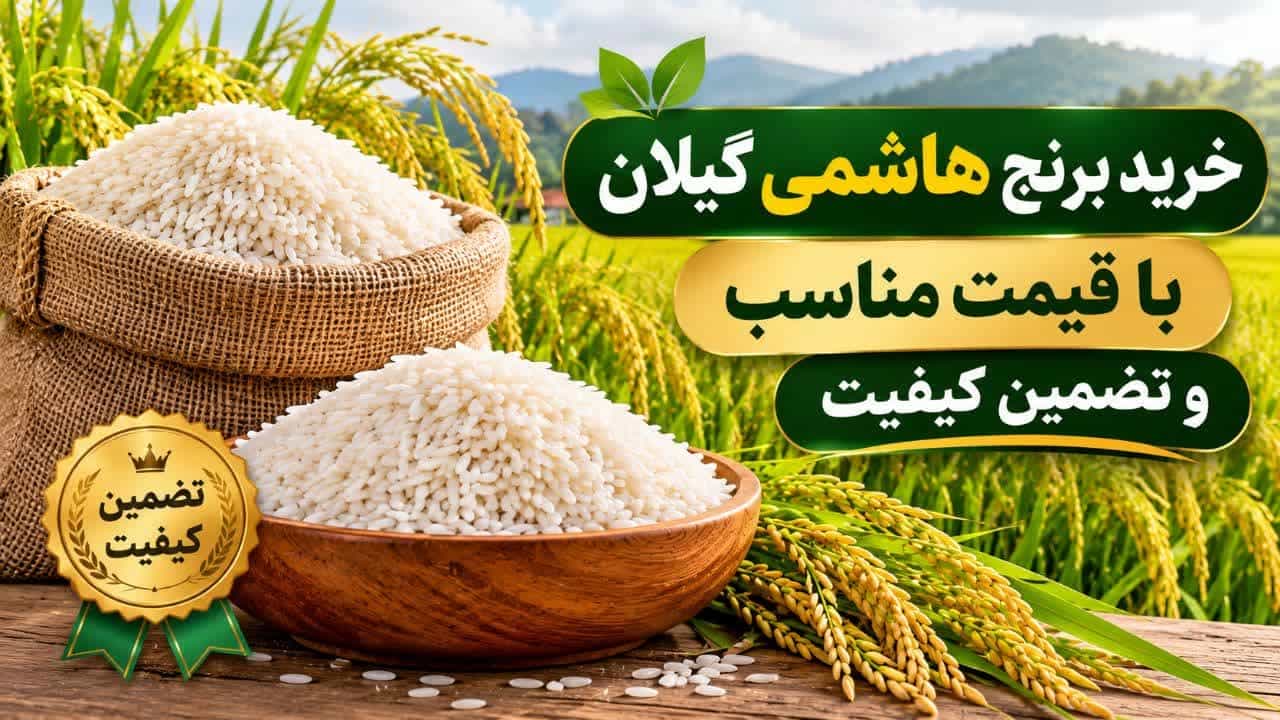
Purchasing Hashemi rice from Gilan at a reasonable price requires eliminating seasonal brokers, buying directly from reliable rice milling factories and physically matching the grains based on the characteristics of the original origin (especially the paddy fields on the outskirts of Sepidroud). Premium Hashmi rice has pen grains about 7.3 mm long, creamy white color and a lingering aroma after cooking that does not lose its texture even after being heated several times. In the "Hashmi Rice Exchange" collection, this process is implemented based on laser sorting and providing a written guarantee of authenticity so that the final consumer receives a completely uniform product without foreign grains.
Identification of technical characteristics and geographical origin of original Hashemi rice
In the field investigations of Astana Ashrafieh and Rasht rice mills, genuine Hashemi rice is distinguished by a fundamental textural difference compared to other high-yield items: a very fine longitudinal groove and an unbreakable bone structure. The variable weather and the sedimented soil of Sepidroud's margin create a condition where the amyloidosis of Hashemi seeds reaches an exact balance of 21 to 22%; This means a perfect balance between the aroma, freshness and non-stickiness of the seeds after brewing.
Grain dimensions before and after cooking
Gilan standard Hashmi rice before cooking has an average length of 7 to 7.5 mm. After the basic cooking stage, this figure reaches about 12 to 13.5 mm with standard water absorption. Any abnormal increase in length beyond this range is a clear sign of mixing with transgenic or high-yielding varieties such as Shiroudi and Fajr, which have unnatural elongation but lack the richness of oil and the lasting aroma of Gilan rice.
The difference in soil origin and texture quality
Experimental tests show that the fertile paddy fields of Gilan province produce rice with higher grain fat due to the type of soil organic matter. This surface fat prevents pilaf from drying up to 24 hours after cooking. On the other hand, the samples that are cultivated in saline soils or low water soils have more fragile seeds, which increase their fraction during mechanical sorting.
Market fraud tricks and field verification methods
Sensory evaluation: hand rubbing and blowing test
To validate the authenticity of the load, pour some rice between the palms of both hands and raise the temperature of the grains with gentle friction; Then immediately give it warm breathing air. Hashemi seed of Gilan origin releases the natural smell of the rice plant due to the activation of the fatty acid layers. A strong smell or a thick aroma similar to rose water and essential oil is a warning of the presence of chemical essential oil sprayed on old loads.
Structural evaluation by grain breaking
The grain of Hashemi rice breaks under the teeth with a certain resistance and does not show a pasty or chalky texture. The presence of deep white belly in more than 5% of the total volume of the load indicates the unripeness of the seed or systematic mixing with non-standard species. In the Hashemi rice exchange, all loads pass through optical scanners before bagging to completely filter out chalky and stained grains.
The reasons for the difference in Hashemi rice prices in rice farmers' markets and stores
The volatility of Hashmi rice prices is a direct result of several key factors in the supply chain: the ever-increasing cost of labor during the planting and harvesting seasons, the depreciation of industrial drying equipment, and most importantly the number of physical intermediaries to reach the customer.
Paddy threshing and waste sorting costs
Turning paddy into white rice requires several stages of peeling, bleaching and polishing. In this process, part of the load is converted into semi-grain and carcass. Units that offer unreasonably low prices usually omit the second step of sieving and re-drying so that the weight of the load does not decrease; In this way, the buyer faces 10-15% hidden waste.
The effect of basic storage and dehumidification
Rice after harvest contains 22-25% moisture. The gradual and accurate reduction of this humidity to the limit of 10-12% in indirect heat ovens stabilizes the quality of seeds. Factories that dehumidify quickly and at high temperatures to save time produce rice that crumbles or crumbles quickly during cooking.
The standard method of cooking Hashmi rice for maximum height and aroma
Achieving the best output of premium rice requires understanding the high sensitivity of Hashemi grain texture to water and heat. The behavior of Hashemi grain is fundamentally different from imported long grain rice due to the low thickness of starch.
Preparation and soaking steps
Fresh Hashemi rice (rice cultivated this year) has a more sensitive texture; Therefore, washing it should be done with lukewarm water without rough handling so as not to destroy the outer oily layer. The proper time to soak in salt water is 2 hours for this year's rice and 3-4 hours for last year's rice. Heavy salt hardens the gluten bonds and prevents the grain from bursting in boiling water.
Time management in boiling and brewing
During the boiling stage, the seed is ready to be rinsed when its edges are soft and its core is slightly resistant. After rinsing, a strong squeegee will break the length of the seeds. Hashmi rice needs a gentle flame, uniform distribution of steam and at least 35 to 45 minutes to show its full height.
Advantages of direct supply from Hashemi Rice Exchange
Buying from the supply chain without intermediaries reduces the risk of common market frauds to zero. The Hashemi Rice Exchange has provided a transparent mechanism for wholesale and retail distribution by establishing itself in the heart of Gilan production and aggregating the products of leading farmers.
Advanced sorting and accurate granularity
Our products are sorted in 3 separate stages: physical sifting to remove stones and debris, granulation sieve to separate semi-grains and carcasses, and optical sorting to remove yellow, black or chalky grains. The result of this process is perfectly uniform bags with guaranteed purity.
Guaranteed return after cooking
To provide complete reassurance for home consumers and restaurants, packages are shipped with a cook-test guarantee. In case of non-compliance with the mentioned quality criteria, the possibility of full return of the cargo and unconditional refund of the buyer's money is guaranteed.
Evaluation Index | Premium Hashmi Rice (Hashmi Rice Exchange) | High yielding rices (Shirodi/Fajr) | Poor quality and mixed market rice |
Grain length before cooking | 7.2 to 7.5 mm | 7.0 to 8.0 mm | Heterogeneous (6 to 8 mm) |
Recovery rate (after inhalation) | 12.5 to 13.5 mm | 11.5 to 12.5 mm | variable and fragmented |
percent fracture (fine grain) | less than 2 Percentage | Between 5 and 10% | above 12% |
Persistence of texture after cooling | up to 24 hours soft and Flexible | Dries and hardens quickly | sticky and brittle state |
natural aroma and taste | stable, natural and Thick | Mild or unscented | Artificial or odorless |
Cleaning process | Sorting Three-stage laser | One-stage mechanical sorting | Traditional and containing impurities |